Anton Busquets i Punset
Anton Busquets i Punset was born in Sant Hilari Sacalm on October 20, 1876, and died in Calders on August 19, 1934. He was a prolific writer, a teacher, a committed journalist, and a staunch advocate for Catalan culture.
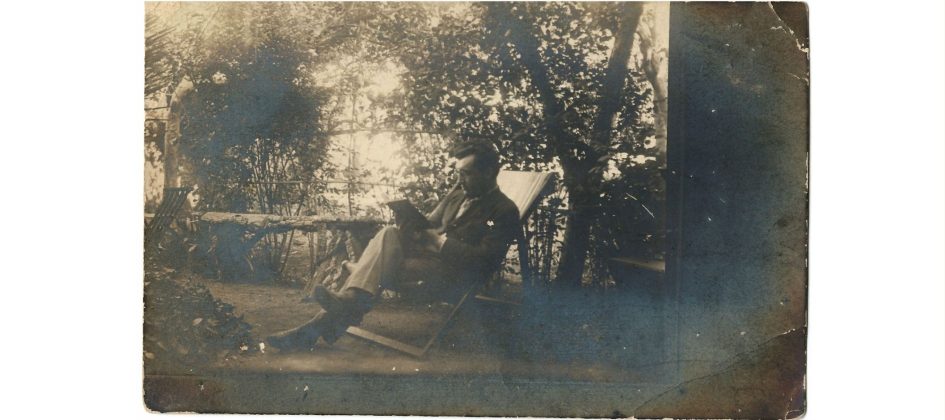
The origins: a rural world
Anton Busquets i Punset was born at the site now known as Cal Enric. He was the son of a local baker, popularly known as “en Pepito”, while his mother hailed from Ripoll. When he was only seven years old, his father passed away, and the family endured a very difficult period. His mother remarried, but her new husband eventually abandoned them. They moved to Ripoll to live with his grandparents, where young Anton continued his education.
This childhood, spent between Sant Hilari and Ripoll, profoundly shaped his perspective on the world. From a very young age, he enjoyed slipping away into the woods to talk with “roders”, charcoal burners, and woodcutters. From them, he learned songs, legends, sayings, and jokes—elements that would later form the foundation of his rich vocabulary and the imaginative world of his literary work. Busquets absorbed folk culture by listening to the mountain people.
At the age of nineteen, while living in Ripoll, he published his first book of poems, Lliroya (1895). Shortly thereafter, he moved to Vic to complete his secondary education and began studies at the Seminary. During this time, he met Jacint Verdaguer in person, forging a deep friendship that lasted until the poet’s death in 1902.
A young man committed to Catalanism
At the age of twenty, Busquets left the seminary and settled in Barcelona with his mother and sister. He faced significant financial hardship, yet he continued his literary and journalistic pursuits. He contributed to—and served as one of the primary editors for—the magazine L’Atlàntida, which was founded with the blessing of Verdaguer.
Between 1900 and 1910, he experienced a period of intense cultural and political activity. In 1900, he won the Jocs Florals of Sants; his prize was a portrait of himself created by a young artist from the Quatre Gats circle named Pablo Ruiz Picasso. He joined the Unió Catalanista (Catalanist Union)—the organization behind the Bases de Manresa—and took part in numerous rallies and lectures centered on patriotic and cultural themes.
He was also a member of the editorial staff for the modernist weekly Joventut and contributed to publications such as L’Esquella de la Torratxa and ¡Cu-cut!. For Busquets, writing was more than just a literary vocation; it was a means of participating in public life and defending Catalan identity.
A committed teacher
However, the great vocation of Anton Busquets i Punset was teaching. The Unió Catalanista advocated for the teaching of the Catalan language and the establishment of Catalan schools, and he participated actively in this endeavor. In 1902, together with a small group of enthusiasts, he founded the Escoles Catalanes Mossèn Cinto (Priest Cinto Catalan Schools), which he directed himself. The following year, he opened and ran the Escola del Foment d’Instrucció (Instruction Development School) in Sant Vicenç dels Horts, and in 1906, he was appointed director of the Escoles Catalanes Doctor Robert (Doctor Robert Catalan Schools) in L’Hospitalet de Llobregat.
After serving as a temporary teacher in Amer and Roses, he passed the competitive civil service examination for teachers in 1913 and deliberately chose a rural school—a setting he considered his true calling. He secured a position in Salo, in the municipality of Sant Mateu de Bages, where he taught for nine years. It was there that he met Josefa Pascual, a teacher for girls in Pinós; they later married and had two daughters. In 1921, he moved to Calders, where his wife had already been appointed as a tenured teacher, and he took charge of the school for boys.
Busquets held a very clear philosophy: mere instruction—imparting knowledge to students—was not enough; they needed to be educated in a holistic, comprehensive way. To this end, he promoted field trips, school camps, engagement with nature, Catalan music, hygiene, and the study of local traditions. He wanted children to develop a love for their country, nature, and culture, and to learn to express their feelings with sincerity. He was a progressive teacher for his time. When the first works on “centers of interest”—the foundation of the Decroly pedagogical method—were published, he had already begun applying them in Salo. He also established the Novell Esbart Cantaire (New Singers Group; a folk dance and singing group) at the Escoles Catalanes Doctor Robert, with the aim of fostering a love for Catalan folklore and music among the children.
His humanity was another of his most notable traits. Children from very distant villages and isolated farmsteads—such as Claret de Cavallers, Mejà, Castelltallat, Matamargó, and Vallmanya—attended school in Salo. Whenever it rained, a strong wind blew, or darkness fell, Busquets would not allow the children to make the journey home alone across the countryside; instead, he would keep them at the school, warm up their lunches by the hearth, and, if necessary, set up a mattress for them to sleep on. He was a teacher who looked after his students well beyond school hours.
During the dictatorship of Primo de Rivera, his status as a Catalanist and a pedagogically progressive teacher led to him being placed under surveillance and subjected to pressure. According to his friend Eduard Girbal i Jaume, had the inspectors yielded to the regime’s demands, Busquets would have been at the top of the list of targeted teachers. He continued to work at the rural school for the rest of his life, even though he could have secured more comfortable positions in larger cities.
A writer rooted in the rural world
The literary output of Anton Busquets i Punset is extensive and varied. He published poetry, narrative works, and books intended for school use. Notable among his works are Flors del Montseny (1897), Ventitjols de Guillería (1901), Del Montseny (1903), Dos amors (1907), Ànimes ferides (1907), Plantalamor (1908), Calvari (1917), Amor de senyor (1918) and Del meu viure rural (1929).
His work is characterized by three highly recognizable traits: a Christian spirit inherited from the Renaixença (the Catalan cultural revival), a firm commitment to rural life, and a deep devotion to the most authentic, deeply rooted form of the Catalan language. Busquets believed that the virtues and flaws of the Catalan people were rooted in the peasantry, and that the most genuine form of the language was preserved, above all, in the speech of those living in the mountains and the countryside.
This conviction is particularly evident in Del Montseny, a book that describes life in the Guilleries country at the end of the 19th century. It features trades that have since disappeared or undergone significant transformation—such as “roders” (workers engaged in the felling and processing of young chestnut trees wood), “carboners” (charcoal burners), “traginers” (carters), “espardenyers” (espadrille makers), and “campaners” (bell crafters)—as well as tools, clothing, food, musical instruments, folk songs, and expressions specific to the country. Consequently, his work holds great ethnographic value: it serves as a window into the way of life of our ancestors.
His vocabulary is extraordinarily rich and precise. Busquets contributed terms from the Guilleries region and from popular speech to such prominent lexicographers as Marià Aguiló and Mossèn Antoni M. Alcover. He collaborated on the Diccionari català-valencià-balear and took an active part in the Congrés Internacional de la Llengua Catalana (International Congress of the Catalan Language) in 1906. For him, language was not merely an instrument of communication; it was the foundation of a people’s cultural identity.
Aplech: a book for learning to read Catalonia
One of his most notable contributions was Aplech. Models en vers y en prosa del nostre Renaixement (1906), a reader compiled and organized by him. It was the first anthology of modern Catalan literature designed for school use, and it achieved widespread circulation: most children during the first third of the 20th century used it.
A man well connected to the culture of his time
Anton Busquets i Punset was not an isolated figure. He maintained friendships and connections with some of the most prominent names in Catalan and European culture of his time—such as Jacint Verdaguer (with whom he had a very close relationship), Àngel Guimerà, Joan Maragall, Narcís Oller, Joaquim Ruyra, Apel·les Mestres, Víctor Català, and Martí Genís i Aguilar—as well as the Provençal poet Frederic Mistral.
He was also a major advocate for the Jocs Florals throughout Catalonia and founded Els Romeus, an organization that succeeded the Esbart de Vic. His presence in Catalan cultural life remained constant for decades, spanning his work in education, the press, and literary circles.
His Years in Calders
Busquets i Punset arrived in Calders in 1921 and lived there until his death in 1934. There he continued to work as a teacher and, from 1926, he took charge of the Revista il·lustrada Jorba (Jorba Illustrated Magazine), which he directed until his death. This magazine dedicated an entire issue to his memory. The following year, in 1935, Calders Village Council and the Associació de Periodistes de Barcelona (Association of Journalists of Barcelona) paid tribute to him in two events: one in Calders, where the street where he had lived was named after him, and the other at the headquarters of the Associació de Periodistes in Barcelona.
Information taken from: CERAROLS CORTINA, Lluís. «Anton Busquets i Punset: activista cultural i polític, mestre de minyons, escriptor i periodista». Modilianum, 2024, núm. 70, pp. 65-74. https://raco.cat/index.php/Modilianum/article/view/435834
In Sant Hilari, there is a Literary Route, which passes through different parts of the town, where the most outstanding literary works are collected, including those by Anton Busquets and Punset. Further information.